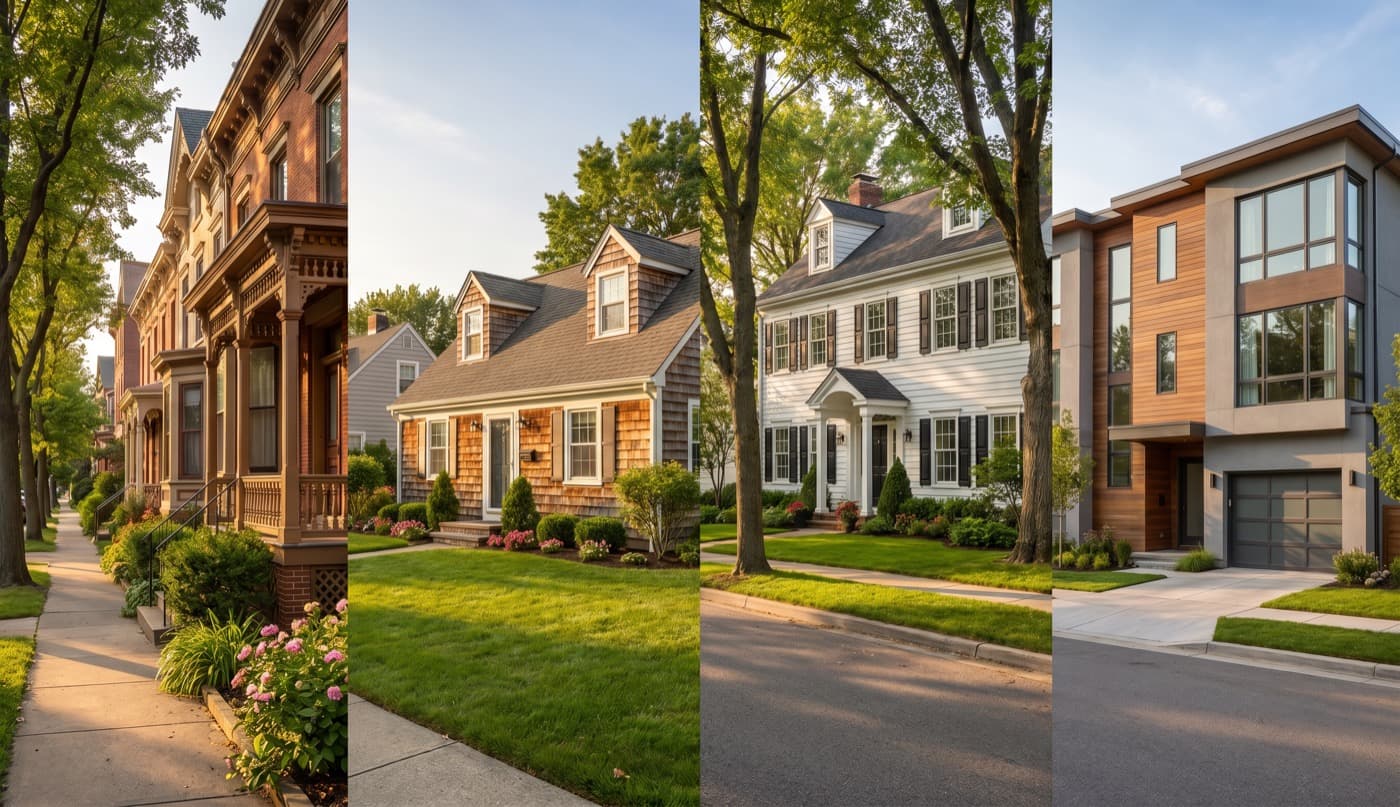
New Jersey has one of the most varied housing markets in the country. Within a single county you might find a 1920s Victorian row home, a 1960s split-level ranch, a brand-new townhouse, and a converted industrial loft, all priced very differently and suited to different buyers.
The type of home you buy affects your mortgage, your monthly costs, what you can renovate, and how easy the home will be to sell later. Here are the major home types you'll find in New Jersey and what each one means for you.
Single-family detached homes
This is the most common home type in NJ outside the urban cores. You own the structure and the land it sits on, with no shared walls. You get privacy and outdoor space (a yard, driveway, or garage) and full control over renovations, with no HOA approval needed unless the home is in a planned community. Historically, single-family homes have had the strongest appreciation and the easiest resale.
Single-family homes dominate suburban counties like Morris, Somerset, Monmouth, and Burlington. Median prices range from the high $200Ks in Salem and Cumberland counties (as of May 2026) to over $800K in parts of Morris and Somerset.
Townhouses
A townhouse shares side walls with one or two neighboring units but has its own entrance, typically multiple floors, and often a small yard or patio. You own the interior and sometimes the land under the unit. You get more space than a condo at a lower price than a detached single-family, and usually less maintenance, since many townhouse communities handle lawn care and exterior upkeep through the HOA. Townhouses are common in new construction developments throughout suburban NJ.
They're everywhere in Hudson, Bergen, Middlesex, and Monmouth counties, and especially popular with first-time buyers and commuters who want more space than a condo but can't afford a detached home near transit.
The cost to watch is the HOA fee, and $200–$600/month is common. I'd always request the HOA financials and reserve fund balance before making an offer, because underfunded reserves mean a special assessment is coming.
Condominiums
In a condo you own your individual unit and share ownership of common areas (hallways, gym, parking, roof) with the other unit owners through a condo association. It's the lowest-maintenance option, since the association handles the exterior, roof, and grounds. You also get amenities such as a gym, concierge, or rooftop that would be unaffordable in a single-family, and condos are often the most affordable entry point in urban markets like Jersey City, Hoboken, and Newark.
Condos dominate Hudson County and parts of Bergen and Essex. New construction high-rises in Jersey City and Hoboken start around $500K for a one-bedroom. Older mid-rise buildings in the suburbs offer much better value.
Watch out for:
- HOA fees, which can run $500–$2,000+/month in urban buildings with amenities.
- FHA/VA financing restrictions. Some condo buildings aren't FHA-approved, which limits your buyer pool when you sell.
- Rental restrictions. Many buildings cap the number of units that can be rented, which matters if you plan to lease the unit later.
Co-ops (cooperative housing)
In a co-op you don't technically own real estate. You own shares in a corporation that owns the building, and your shares entitle you to a proprietary lease on your unit.
Co-ops often have lower purchase prices than comparable condos.
Co-ops are far less common in NJ than in Manhattan, but they do exist in Hudson County and in older Bergen County buildings.
Watch out for:
- The board approval process, which can be lengthy and intrusive. Boards can reject buyers without explanation.
- Harder financing. Fewer lenders offer co-op loans, and down payment requirements are often higher.
- Subletting restrictions. Many co-ops prohibit or severely limit renting your unit.
The lower price comes with a slower, less certain purchase and less freedom to rent your unit later.
Multi-family homes (2–4 units)
A multi-family home is a single structure with two to four separate residential units. You can live in one unit and rent the others (house hacking), or rent all of them as a pure investment. The rent offsets your mortgage, sometimes dramatically, and residential financing (conventional, FHA) is available for 2–4 unit properties, so you don't need a commercial loan. For a first-time investor, I think it's the best way into NJ real estate.
Two-family and three-family homes are prevalent throughout Hudson, Essex, Passaic, and Union counties. A two-family in Jersey City or Newark can generate $3,000–$5,000/month in combined rent on a $600K–$800K purchase. Run the numbers with the investment calculator.
Watch out for:
- Tenant management responsibilities if you're the landlord.
- NJ's strong tenant protections. Understand the laws before you buy a tenant-occupied property.
- Capital improvements. Older multi-family buildings often need significant work.
Split-level and bi-level homes
Split-levels and bi-levels are a distinctly suburban NJ style from the 1950s–1970s. The living spaces are staggered across half-floors connected by short stairways, instead of full floors stacked on top of each other. That separates the living, sleeping, and utility spaces without a full multi-story layout. You often get good square footage for the price, since split-levels are sometimes undervalued relative to colonials, and large lots are common in the 1960s–70s developments where they were built.
You'll find them throughout Morris, Union, Essex, and Bergen counties in postwar suburban neighborhoods. They tend to sell at a modest discount to comparable colonials, which makes them worth a look if you don't mind the style.
Cape Cod homes
A Cape Cod is a classic American style: one and a half stories with a steep pitched roof, dormers, and bedrooms on the upper half-level. The floor plan is compact and efficient, with plenty of character. Because square footage is limited, a Cape is often the most affordable single-family option in a neighborhood, and the dormers can be expanded to add full bedrooms.
Capes are common in Monmouth, Ocean, and Burlington counties, often in beach-adjacent towns or established postwar neighborhoods. They're some of the best value in markets where detached homes otherwise start above $500K.
New construction
New construction means brand-new homes built by a developer, either in a planned community or as a standalone custom build, and you're the first owner. You get modern systems, energy efficiency, and builder warranties (typically 1/2/10 years on different components), plus customization options for finishes and layout if you buy early in the build phase. Everything is new, so there are no deferred maintenance surprises.
New construction is most active in Burlington, Ocean, Monmouth, and Somerset counties, where land is available. In-fill new construction (single lots in established neighborhoods) appears throughout Hudson and Essex. Prices carry a significant premium, typically 15–25% above comparable resale.
Watch out for:
- Builder contracts, which heavily favor the builder. Always have a real estate attorney review one before you sign.
- HOA fees in new communities, which are often set artificially low and rise after the builder turns control over to homeowners.
- "Fully upgraded" model homes, which set expectations that don't match base pricing.
Whether the 15–25% premium is worth it depends on how much a house with no deferred maintenance is worth to you. See the full new construction vs. resale breakdown.
Which home type is right for you?
| Goal | Best Home Type |
|---|---|
| Maximum space + privacy | Single-family detached |
| Urban living with low maintenance | Condo or townhouse |
| Enter real estate investing | 2–4 family |
| Lowest entry price, detached | Cape Cod or split-level |
| Modern construction, no surprises | New construction |
| Offset mortgage with rental income | Multi-family (house hack) |
The right choice also depends heavily on which county and price range you're working in. A $500K budget in Hudson County looks very different from $500K in Burlington or Ocean.
Know what you're buying before you make an offer
Every home type has different financing rules, ongoing costs, and long-term considerations. A condo with a $600/month HOA fee is a different financial decision from a detached home at the same purchase price.
If you're figuring out which home type fits your goals, and what your budget looks like across different NJ markets, I can walk through the numbers with you. You can also explore NJ market data by county.
Related reading
- House Hacking in NJ: live in one unit of a 2–4 family and rent the others
- New Construction vs. Resale in NJ: whether the new-construction premium is worth it
- First-Time Home Buyer's Guide to New Jersey (2026): the full buying process, NJ-specific