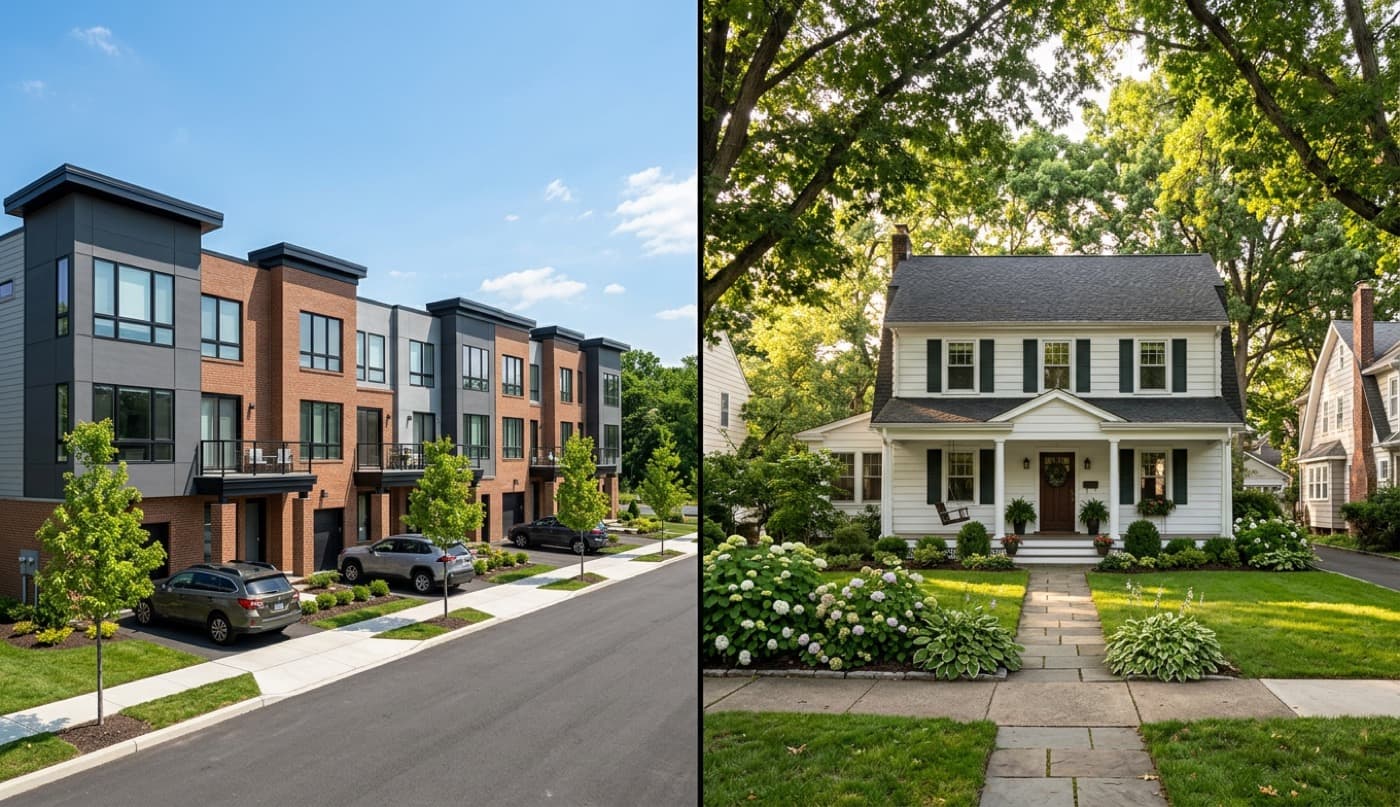
One of the first decisions NJ buyers face gets surprisingly little discussion: new construction or resale? Buyers usually start with "I want something move-in ready with no surprises" and assume new construction is the answer. It isn't always that simple.
Both paths have real advantages and real trade-offs. The right choice depends on your county, your budget, your timeline, and how much you're willing to deal with. Here's a straight comparison.
The short version: New construction gets you a builder warranty and no deferred maintenance, but in most NJ markets it runs 15–25% more per square foot, and to-be-built homes take 6 to 18 months. Resale usually wins on location, price, and speed, and in Hudson, Bergen, and Essex I'd treat it as the default. Start with where you want to live, then see whether a new build exists there at a price that works.
What "new construction" means in NJ
In New Jersey, new construction comes in several forms:
- Spec homes: the builder started (or finished) the home without a specific buyer, and you choose from the available lots or units
- To-be-built homes: you pick a lot, choose a floor plan, and customize finishes before construction begins
- Condo and townhome developments: new planned communities, common in Hudson, Middlesex, and Burlington counties
- Conversion projects: older commercial buildings converted to residential use (particularly in Hudson County)
New construction doesn't always mean you're the first person through the door. A spec home that has sat on the market for 6+ months may have aged finishes and a motivated builder, so know exactly what you're buying.
The case for new construction
1. No deferred maintenance
This is the number-one reason buyers go new. New Jersey's resale housing stock is old: the median age of a New Jersey home is over 50 years. That means aging electrical panels, galvanized plumbing, oil tanks, knob-and-tube wiring, and roofs that were last replaced when your parents were in college.
With new construction, the roof, HVAC, water heater, appliances, and other systems all start at day one. You're not inheriting someone else's deferred maintenance list.
2. Builder warranty coverage
Under the New Home Warranty Act (N.J.S.A. 46:3B), whose warranty program is run by the NJ Department of Community Affairs (Bureau of Homeowner Protection), NJ builders are required to provide:
- 1 year on workmanship and materials
- 2 years on plumbing, electrical, heating, and cooling systems
- 10 years on major structural defects
That's real protection, and a resale home has nothing like it. Once you close on a resale, you own whatever breaks next.
3. Modern energy efficiency
New homes built to 2026 NJ energy codes are significantly more efficient than older resale homes, with better insulation, low-E windows, high-efficiency HVAC systems, and smart home wiring. Utility bills on a new 2,000 sq ft home can run $100–$200/month less than in a comparable older resale.
4. Customization (if you're early enough)
If you buy a to-be-built home before the builder has finished the interior, you can often choose finishes such as cabinet colors, countertops, flooring, and fixtures. You get something closer to "your home" without the cost and headache of a renovation.
5. No bidding wars (usually)
Resale homes in in-demand NJ markets often attract multiple offers within days. New construction typically doesn't. You negotiate directly with the builder, and that negotiation is more predictable.
The case for resale
1. Better locations
This is resale's biggest advantage, and it often settles the question. New construction in NJ happens where land is available, which often isn't where you want to live.
You won't find a new construction townhome half a block from the Hoboken PATH station, or a new build on a mature, tree-lined street in Montclair or Summit. The best locations in Hudson, Bergen, and Essex counties are already built out. If location is your priority, resale usually wins.
2. Lower price per square foot
New construction commands a premium. In most NJ markets, new construction runs 15–25% more per square foot than comparable resale homes. Here's a rough comparison using January 2026 resale medians:
| County | Resale Median | New Construction Premium | Approx. New Build Price |
|---|---|---|---|
| Hudson | $699K | +15–20% | $800K–$840K |
| Bergen | $731K | +15–25% | $840K–$915K |
| Middlesex | $520K | +20–25% | $624K–$650K |
| Burlington | $390K | +10–15% | $429K–$449K |
| Ocean | $462K | +10–20% | $508K–$554K |
Note: Estimates based on Redfin Jan 2026 data and agent market knowledge of active NJ builder communities. Actual premiums vary by development and are not guaranteed.
For a buyer stretching their budget, that premium often means a smaller home or a less desirable lot, and neither is usually the goal.
3. Faster closing
Resale homes can close in 30–60 days. To-be-built timelines in NJ range from 6 to 18 months, and delays are common because of permitting, supply chains, and labor availability. If you need to be in a home by a specific date (a lease ending, school enrollment, a job start), resale is far more reliable.
4. Established neighborhoods
With resale, you can see exactly what you're buying into: the street, the backyard, the noise level, and how close you are to amenities. In a new development, especially a larger one, you may move in while surrounding lots are still under construction and live with noise and dust for months or years.
5. Negotiating power
In a balanced market, resale sellers have flexibility that builders typically don't. You can negotiate closing cost credits, repairs, a lower price, or furniture. Builders in competitive markets tend to hold firm on price, though they may offer upgrades or closing cost contributions instead.
The hidden costs of new construction in NJ
Several costs catch buyers off guard with new builds. Upgrades add up fastest, because the model home is rarely the base model: buyers often spend $30,000–$100,000 above base price to get what they want.
| Cost | Typical range | Note |
|---|---|---|
| Lot premiums | $10,000–$75,000 | For preferred lots: corner lots, cul-de-sacs, lots backing to open space |
| Upgrades | $30,000–$100,000 | Granite counters, hardwood floors, finished basements, and upgraded appliances are all extras |
| Landscaping and window treatments | $5,000–$25,000 in the first year | Many new homes come with graded but unfinished yards and no window coverings |
| HOA fees | $200–$600/month | Common-area maintenance in many new NJ developments, on top of your mortgage |
| Property tax reassessment | Depends on the town | Once reassessed, a newly built $600K home may be assessed well above nearby resale comparables |
Some municipalities don't reassess new construction immediately, so the bill can jump after you move in. Check the tax history and pending assessment status before you close.
When to choose new construction
New construction makes the most sense when:
- You can't stomach repairs and want everything under warranty for the first few years
- You're buying in a growth corridor where new inventory sits near decent transit or amenities (e.g., South Jersey counties, parts of Middlesex along the NJ Transit lines)
- You're buying a condo or townhome, where new development competes with resale on price and location
- You have a flexible timeline and can wait 6–18 months for delivery
- Energy efficiency and modern systems are a priority (especially for all-electric homes with solar-ready construction)
When to choose resale
Resale is usually the better call when:
- Location is non-negotiable: walkable neighborhoods, transit access, specific towns
- You're on a tight budget and need the most square footage for your dollar
- You need to close in 60 days or less
- You're buying in Hudson, Bergen, or Essex County, where new construction supply is limited and expensive
- You want character. Older NJ homes have architectural details (original hardwood floors, crown molding, solid construction) that new builds rarely replicate
What to watch for in builder contracts
If you do go with new construction, keep in mind that builder contracts are written to protect the builder. Negotiate these points before you sign:
- Deposit structure. Builders typically require 5–10% upfront. Find out what happens to your deposit if the project is delayed or cancelled, or if you can't close.
- Completion date. "Estimated" delivery dates are almost never guaranteed. Get any promised delivery window in writing and ask about penalty clauses for delays.
- Upgrade allowances. Negotiate upgrade credits into the base contract price rather than paying for them separately, because that affects your loan amount and appraisal.
- Independent inspection. You have the right to a third-party inspection on a new build, and I'd use it. New homes still have defects: framing errors, faulty HVAC installations, and waterproofing issues happen.
- Your own attorney. Builders provide contracts and sometimes attorneys, and those attorneys work for the builder. Hire your own for the attorney review period.
My take for 2026
As of early 2026, the NJ market had more inventory than in 2021–2022, but not enough to make this an easy buyer's market everywhere. In Hudson, Bergen, and Essex counties, new construction supply was limited and expensive, and I'd treat resale as the default there almost every time.
Middlesex, Burlington, and Ocean counties have meaningful new construction activity at competitive price points. Buyers open to South Jersey or the Route 9 corridor have real options in both categories.
The question I ask every buyer is where they want to live. Start with location and commute. If a new build exists there at a price that works, it deserves a serious look. If not, I wouldn't let the appeal of "new" pull you to a location you don't want.
I can pull the current new and resale inventory for any area you're weighing and walk you through the real numbers. Call or text me at 609-582-1930.
Related reading
- First-Time Home Buyer's Guide to New Jersey (2026): the full buying process from pre-approval to closing
- 7 Home Buying Myths That Cost NJ Buyers Money: which common beliefs hold up against the numbers
- Why Mortgage Rates Don't Follow the Fed: what drives the rate you'll be quoted