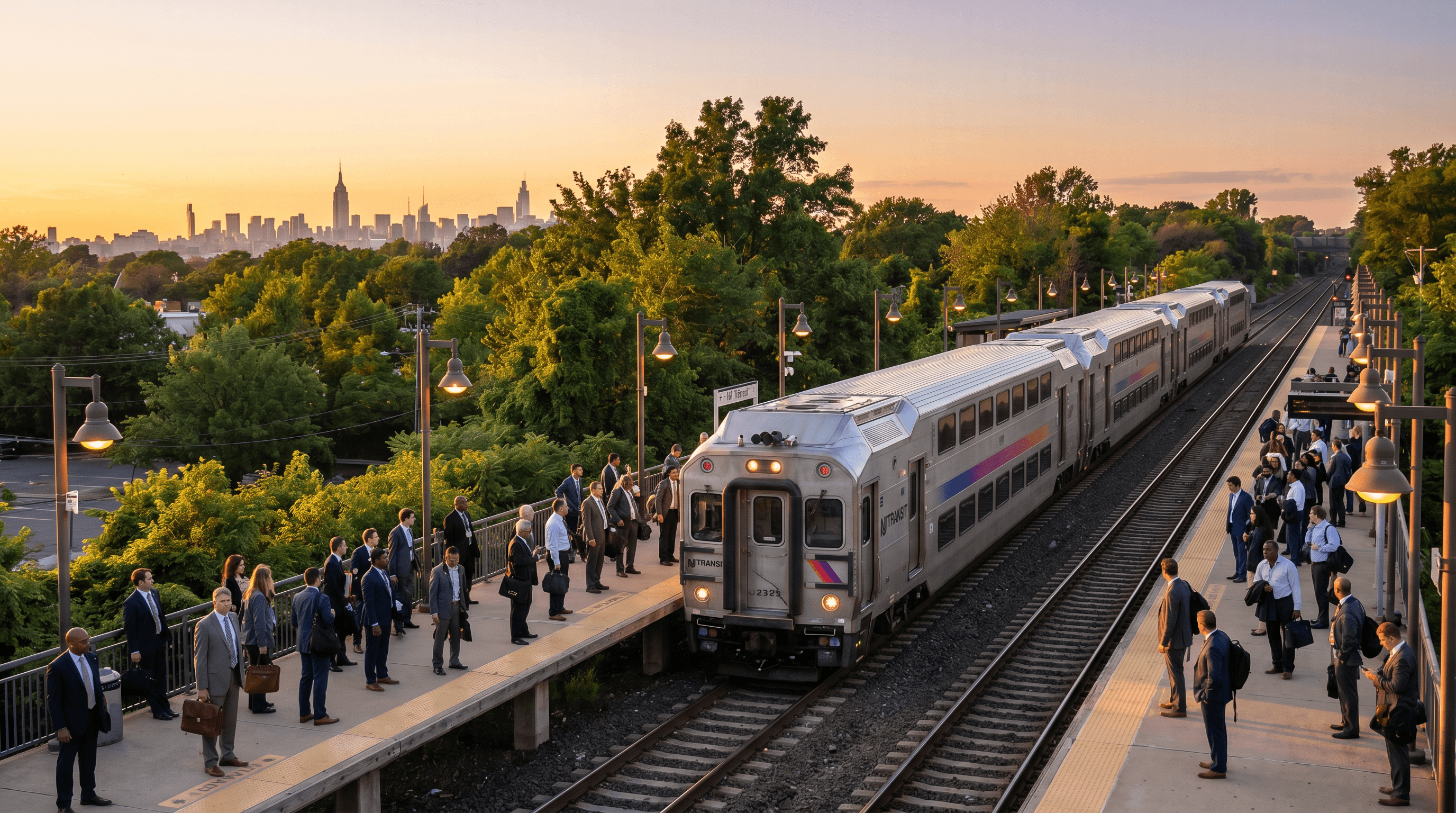
Living in New Jersey and working in New York City still pencils out in 2026. A 45-minute NJ Transit ride gets you from a 4-bedroom colonial with a yard to midtown Manhattan. The same money in Brooklyn gets you a 2-bedroom co-op with a maintenance fee and a neighbor whose workout schedule you'll learn to resent.
NJ towns don't all commute equally, though. A 28-minute express and a 65-minute local with a transfer are very different ways to start your day. Below are the towns I'd look at first, grouped by how long the ride takes, with the price range and the tradeoffs for each.
How NJ commuters get to Manhattan
There are three main ways in.
PATH
The PATH train (Port Authority Trans-Hudson) runs from Newark, Harrison, Journal Square, and Hoboken to the World Trade Center, and from Journal Square and Hoboken to 33rd Street. Trains come every 3–10 minutes at peak, there are no seat reservations, and the fare is a flat $3.25 (as of October 2026). It's the fastest NJ-to-NYC option by far. Stops include Hoboken, Jersey City (Grove St, Exchange Place, Newport), Harrison, and Newark.
NJ Transit rail
NJ Transit rail is seat-based commuter rail into Penn Station (34th St) or Hoboken Terminal. Tickets are priced by zone ($5–$17 one-way). It runs less often than PATH but covers much more of the state. These are the lines most commuters use:
- Morris & Essex (Summit, Millburn, Maplewood, Chatham, Madison)
- Raritan Valley (Westfield, Cranford)
- Main/Bergen (Ridgewood, Glen Rock)
- Montclair-Boonton (Montclair, Glen Ridge, Bloomfield)
- Northeast Corridor (New Brunswick, Metuchen, Rahway)
Express buses and ferries
Express buses and ferries fill in for some towns without direct rail: buses run to the Port Authority Bus Terminal, and ferries leave from the Monmouth/Bergen shore. They're generally slower and less reliable than rail, but worth a look on specific corridors.
Under 30 minutes to Manhattan: PATH towns
These are the closest-in NJ communities, with urban density, high walkability, and the fastest possible commute. Prices reflect it.
Hoboken (Hudson County)
The PATH takes 5–12 minutes to WTC or 33rd St from Hoboken Terminal, the city's one PATH station, which has direct trains to both, every 3–5 minutes at peak. Hoboken is dense and walkable, a mix of brownstones and high-rises on the Hudson River waterfront, with a wide range of restaurants and nightlife within walking distance. It feels more like an outer NYC borough than a suburb.
The median price is about $850K–$900K. It's a condo-heavy market, and single-family homes are rare and expensive. The rental market is strong for investment units. Watch for limited parking, flood zone sections near the waterfront, condo fees, and HOA rules that restrict rentals.
Jersey City (Hudson County)
The PATH to WTC takes 10–18 minutes depending on the neighborhood, from the Grove Street, Exchange Place, and Newport stations. Jersey City has a broader range of housing stock and price points than Hoboken. Downtown and Journal Square are dense and urban, Bergen-Lafayette and Greenville have more low-rise residential housing, and the city has seen significant development in recent years.
The median price is about $650K–$750K, and it varies widely by neighborhood, with downtown running higher. Jersey City makes sense if you want to be near Hoboken for less, or if you're an investor looking for rental yield at a lower entry price. Prices, housing stock, flood zones, and the walk to the PATH all vary more within Jersey City than within most towns, so compare specific properties before you buy.
30–45 minutes to Penn Station: the sweet spot
Many of NJ's best-known commuter towns sit in this band, with suburban housing stock, walkable town centers, and rail service direct to Penn Station or Hoboken.
Maplewood & South Orange (Essex County)
NJ Transit's Midtown Direct gets you to Penn Station in 35–42 minutes with no transfer. These are two adjacent towns with walkable village centers and an active local arts scene, with good restaurants along the South Orange Village Center. The housing stock includes Victorian and craftsman homes on tree-lined streets.
Essex County's median was $684K as of April 2026, up 0.6% year over year (YoY). Maplewood and South Orange typically run $550K–$850K depending on size and condition. Both towns are in the South Orange-Maplewood School District; review its data at the NJ School Performance Reports.
Some homes carry deferred maintenance from the 1920s–1940s construction era, and oil tanks are common. Always do a tank sweep before closing.
Montclair (Essex County)
The Montclair-Boonton line takes 38–48 minutes to Penn Station. Some of its trains run Midtown Direct to Penn Station; the rest go to Hoboken, where you transfer. Because the line has fewer Midtown Direct trains than the Morris & Essex line, check specific schedules before you commit. Montclair is one of NJ's best-known commuter towns, with the Montclair Art Museum, a strong arts culture, an active civic life, plenty of restaurants, and a walkable town center that feels urban for a suburb.
Prices run $800K–$1.1M, higher than the Essex County median, and the premium pays for the downtown and the cultural life.
Summit (Union County)
The Morris & Essex line takes 43–52 minutes to Penn Station on express trains with fewer stops, and it's some of the most reliable express service in NJ. Summit has a well-maintained downtown with boutique retail, and its residential streets are lined with large colonials and center-hall properties.
Union County's median was $661K as of April 2026 (-5.6% YoY); Summit itself runs $900K–$1.3M+. The premium is real: you're paying for the express service and the housing stock. Verify which school district serves a specific address (Summit vs. adjacent towns) and review district data at the NJ School Performance Reports.
Glen Ridge & Bloomfield (Essex County)
Both sit just off the Montclair-Boonton line, 30–42 minutes from Penn Station. Glen Ridge is a small, walkable borough with low turnover (owners tend to stay), priced at $700K–$950K. Bloomfield is larger, with more affordable and varied housing stock at $450K–$600K.
I'd look at Glen Ridge if you want Montclair's character at a slight discount, and at Bloomfield if you want a commuter location with Essex County access at a meaningful savings.
45–60 minutes: best value per commute minute
This is where the price-to-commute tradeoff starts working hard in your favor. You add 10–15 minutes to your ride and often cut $200K–$400K from your purchase price.
Westfield (Union County)
The Raritan Valley line takes 50–58 minutes to Penn Station. Most peak trains require a transfer at Newark Penn; the one-seat rides to Penn Station run primarily off-peak, so confirm your specific schedule. Westfield has a downtown with real retail, plus parks, a busy recreation calendar, and Colonial and Tudor homes in great condition.
Prices run $850K–$1.1M, above the Union County median. You pay up for the downtown and the Colonial and Tudor stock, and you take a longer ride than Summit's.
Chatham & Madison (Morris County)
The Morris & Essex line takes 48–58 minutes to Penn Station, with express options. These are two adjacent boroughs with walkable downtowns, consistent real estate demand, and good train frequency. Madison has Drew University and a larger, more varied downtown. Chatham's downtown is smaller and surrounded mostly by single-family streets.
Morris County's median was $698K as of April 2026 (+1.2% YoY, with a 17-day DOM, or days on market). Chatham and Madison run $750K–$1.1M, below Summit's prices for a town center on the same line.
Metuchen (Middlesex County)
The Northeast Corridor takes 45–55 minutes to Penn Station. Metuchen, "The Brainy Borough," has a small, walkable downtown steps from the train station, with regular downtown events.
Middlesex County's median was $530K as of April 2026 (-0.9% YoY), and Metuchen runs $550K–$750K. That's more affordable than most comparable towns in Morris or Union counties, and good value if you want commuter rail and a real town center at Middlesex County prices. The catch is the line itself: the Northeast Corridor is one of NJ Transit's busiest and most delay-prone, so budget a buffer on commute time at peak hours.
Cranford (Union County)
The Raritan Valley line takes 48–56 minutes to Penn Station, and most peak trains require a transfer at Newark Penn. Cranford is an underrated Union County town, with a walkable downtown along the Rahway River, riverside parks, regular downtown events, and housing that ranges from modest ranches to large colonials.
Prices run $550K–$750K, below Summit and Westfield and well below Montclair. If you're priced out of Westfield or Summit but still want Union County rail access, I'd start here.
Ridgewood (Bergen County)
The Main/Bergen line runs to Hoboken, then you take the PATH, for 55–70 minutes total to midtown. You can also take an express bus to Port Authority. Ridgewood is one of Bergen County's highest-priced towns, with a busy downtown and well-maintained housing stock.
Bergen County's median was $778K as of April 2026 (+3.7% YoY); Ridgewood runs $900K–$1.3M+. The two-leg commute (NJ Transit plus PATH) adds complexity and transfer time, which makes it a harder sell if you're commuting 5 days a week and every minute counts.
Quick comparison
| Town | Commute | Price range | Line |
|---|---|---|---|
| Hoboken | 5–12 min | $850K–$900K | PATH |
| Jersey City | 10–18 min | $650K–$750K | PATH |
| Maplewood | 35–42 min | $550K–$850K | Morris & Essex |
| Glen Ridge | 30–42 min | $700K–$950K | Montclair-Boonton |
| Montclair | 38–48 min | $800K–$1.1M | Montclair-Boonton |
| Summit | 43–52 min | $900K–$1.3M+ | Morris & Essex |
| Cranford | 48–56 min | $550K–$750K | Raritan Valley |
| Westfield | 50–58 min | $850K–$1.1M | Raritan Valley |
| Chatham | 48–58 min | $750K–$1.1M | Morris & Essex |
| Metuchen | 45–55 min | $550K–$750K | Northeast Corridor |
| Ridgewood | 55–70 min | $900K–$1.3M+ | Main/Bergen + PATH |
Note: Maplewood's time is on Midtown Direct trains and Summit's is on express trains. Hoboken's range reflects a condo-heavy market. To research schools, look up any district's public data at the NJ School Performance Reports.
What I tell buyers who are new to NJ
- Buy the commute first and the house second. The best house in a town with a bad commute will grind you down, and a smaller house in a town with a reliable 40-minute express makes for a better daily life.
- Ride the actual commute before you commit. Take the train you'd take on a Tuesday morning at 7:45am, because a Saturday afternoon ride tells you very little about the real one.
- Check the trip to the station. Two homes in the same town can be a 10-minute walk or a $12 Uber from the platform, so measure the commute from your front door to your desk.
- Midtown Direct trains are worth paying for. NJ Transit's Midtown Direct service (no transfer, straight to Penn Station) is available on the Morris & Essex line, on some Montclair-Boonton trains, and on some Raritan Valley trains (primarily off-peak). In my experience it's meaningfully more convenient than service that requires a transfer, and the towns it serves command higher prices for that reason.
Finding your town
I work with buyers across 12 NJ counties, from Jersey City to the Jersey Shore, and I know the commuter corridors well. Tell me your commute, your budget, and what you want from daily life, and we can work out which town fits.
Related reading
- First-Time Home Buyer Guide NJ 2026: the full playbook before you start your search
- NJ Real Estate Market Report — April 2026: April 2026 prices for each of the 12 counties
- NJ Closing Costs: What to Expect: budget the full cost before you make an offer
Note: Commute times are estimates based on NJ Transit and PATH published schedules; actual times vary. Median price ranges reflect April 2026 Redfin Data Center county-level data combined with neighborhood-level market knowledge.