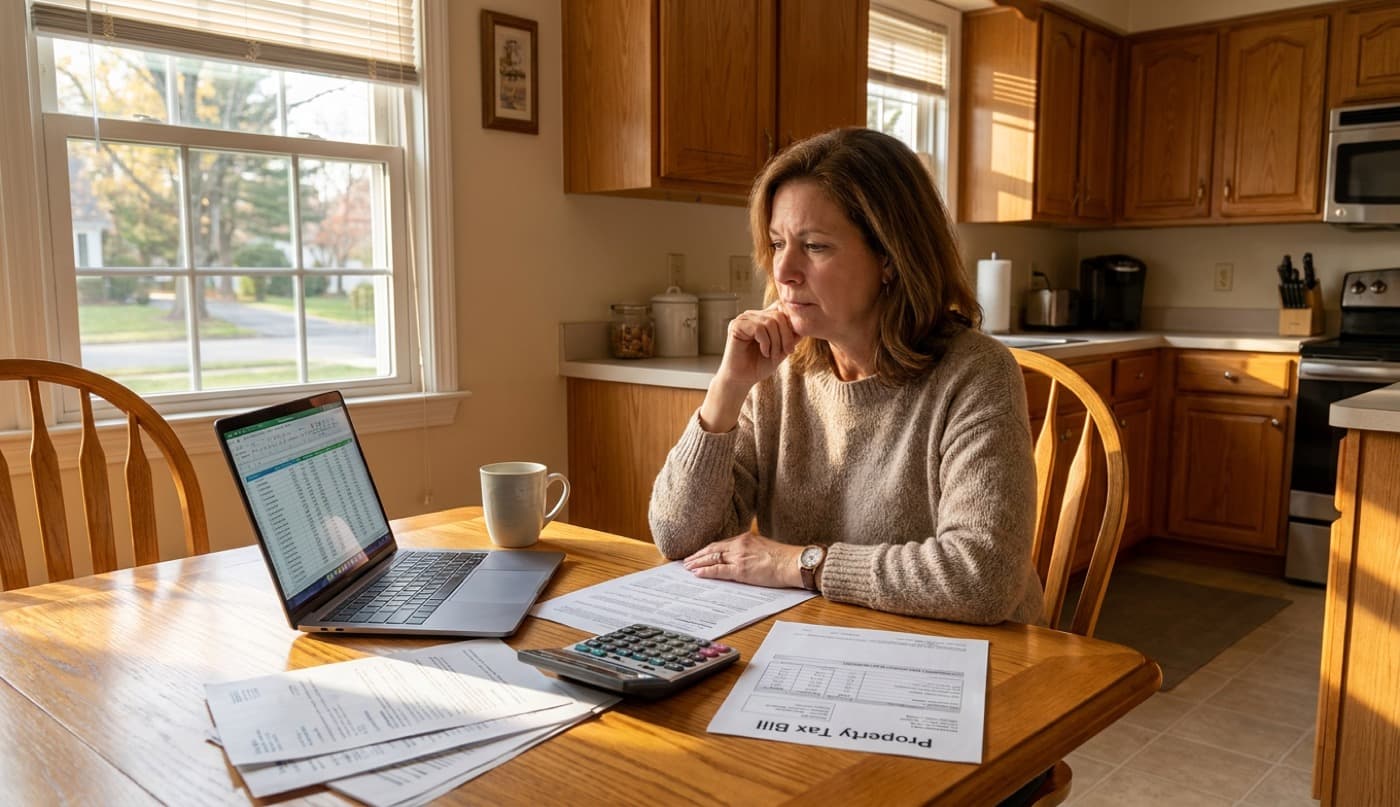
New Jersey has the highest property taxes in the United States, and unlike your mortgage, that bill never goes away. If your home is assessed for more than it's worth, you're overpaying every year, and you have the right to challenge it.
An appeal challenges your assessment, the value the town assigns your home. Get that corrected, and the savings compound year after year.
The short version: You're appealing your assessment, not your tax bill. Divide your assessment by your town's equalization ratio. If recent comparable sales show your home is worth less than that number, you may have a case. File a Form A-1 with your County Board of Taxation before your county's deadline: April 1 for most towns, around January 15 in Monmouth, Burlington, and Gloucester.
A note: This is an educational overview, not legal or tax advice. Deadlines and procedures vary by municipality and change year to year, so always confirm with your County Board of Taxation, and consider a NJ property-tax attorney for higher-value or complex properties.
You're appealing the assessment, not the tax bill
Your property tax is your assessment × the local tax rate. You can't appeal the tax rate, which is set by budgets. What you can challenge is the assessment, and the standard is whether your home is assessed above its true market value, adjusted by the town's equalization ratio. That adjustment is the part that trips people up.
The equalization ratio (a.k.a. the Director's Ratio)
Most NJ towns don't reassess every year, so assessments drift away from real market values. To keep things fair, the state publishes an average ratio for each municipality that shows how assessed values compare to actual sale prices. It's also called the Chapter 123 ratio or Director's Ratio, and the NJ Division of Taxation publishes it every year.
Your assessment ÷ the town's ratio = the market value the town is effectively claiming your home is worth.
Here's a worked example:
- Your home is assessed at $450,000
- Your town's ratio is 85%
- Implied market value = $450,000 ÷ 0.85 = $529,000
Now say recent comparable sales show your home is really worth around $470,000. The town is over-valuing it by roughly $59,000 and you may have a case.
New Jersey builds in a tolerance band called the common level range (roughly ±15% around the ratio). Your case has to fall outside that band for the County Board to lower your assessment. Small discrepancies won't move the needle, so this works best when the gap is meaningful.
The deadlines that matter
This is where most appeals die: people find out after the window closes.
- April 1 of the tax year is the standard deadline for most NJ municipalities.
- May 1 applies if your town did a revaluation or reassessment that year.
- Around January 15 applies in Monmouth, Burlington, and Gloucester counties. They run on the Assessment Demonstration Program (ADP), a completely different and earlier calendar.
Two of those are counties I serve, so in Monmouth or Burlington your window is months earlier than everyone else's.
Assessments reflect value as of October 1 of the prior year, so your evidence should center on sales around that date.
Mark the deadline the moment you suspect you're over-assessed. Miss it, and you wait a full year.
How to know if you have a case
Before you file, do a 20-minute gut check:
- Find your assessment. It's on your tax bill or your municipal tax assessor's records (and on free NJ property-record lookups).
- Divide it by your town's ratio to get the implied market value.
- Compare that with what your home would actually sell for today. If the town's implied value is clearly higher than what comparable homes are selling for, you likely have grounds.
If the numbers are close, an appeal probably isn't worth the effort. If the gap is $40K–$50K or more, I'd take a serious look.
This is one of the fastest things I can sanity-check for a homeowner. A quick pull of comparable sales shows almost immediately whether you're over-assessed.
The evidence that works
County Boards care about one thing: comparable sales. Specifically, you want:
- 3 to 5 recent, arm's-length sales of genuinely similar homes (same town or neighborhood, similar size, age, style, condition)
- Sales close to the October 1 valuation date
- Adjustments for real differences (extra bathroom, bigger lot, finished basement)
Several common arguments don't work. Your neighbor's lower assessment is irrelevant. "My taxes went up too much" is about the rate, not the assessment. Zillow's Zestimate isn't accepted as evidence, and neither are emotional arguments about affordability.
Filing the appeal
For assessments of $1,000,000 or less, you file a Petition of Appeal (Form A-1) with your County Board of Taxation. You can file directly with the New Jersey Tax Court for assessments over $1,000,000. There's a modest filing fee based on your assessed value, typically a small flat amount for a home.
You'll get a hearing before the County Board, where you present your comparable sales. Many hearings are quick and informal. If you disagree with the Board's judgment, you generally have 45 days to appeal to the Tax Court.
Come organized, with your comps, photos, and a one-page summary of why your assessment exceeds true market value.
When to hire a pro
You can absolutely file yourself, and many homeowners do. I'd bring in a NJ property-tax attorney or appraiser when your home is high-value (over $1M) or unusual (hard to find comps), when the potential savings are large enough to justify the fee, or when you want a professional appraisal as evidence.
Many tax-appeal attorneys work on contingency (a share of your first-year savings), so there's often little upfront risk.
The risks of appealing
- Your assessment could go up. If the Board finds you're under-assessed, it can raise it, so tread carefully when your numbers are borderline.
- A win isn't permanent. It lowers your assessment, but a future revaluation can reset it.
- An appeal won't fix a high tax rate. If your town simply spends a lot, even a correct assessment leaves you with a big bill, because appeals only fix over-assessment.
Where to start
The process is more approachable than most people think. Check your assessment against the equalization ratio, pull a few comparable sales, and file before your county's deadline.
For a quick, no-obligation read on whether you're over-assessed, I can run the comparable-sales check I do for clients and neighbors. Request a free home valuation and I'll tell you where your home stands. (That's a comparative market analysis, not an appraisal. If you want a formal appraisal as evidence, use a licensed appraiser.)
Related reading
- NJ Property Taxes Explained: how NJ's system works and what drives the bill
- NJ Closing Costs Guide: every buyer fee itemized
- NJ Real Estate Market Report — July 2026: July 2026 comparable-sales context by county